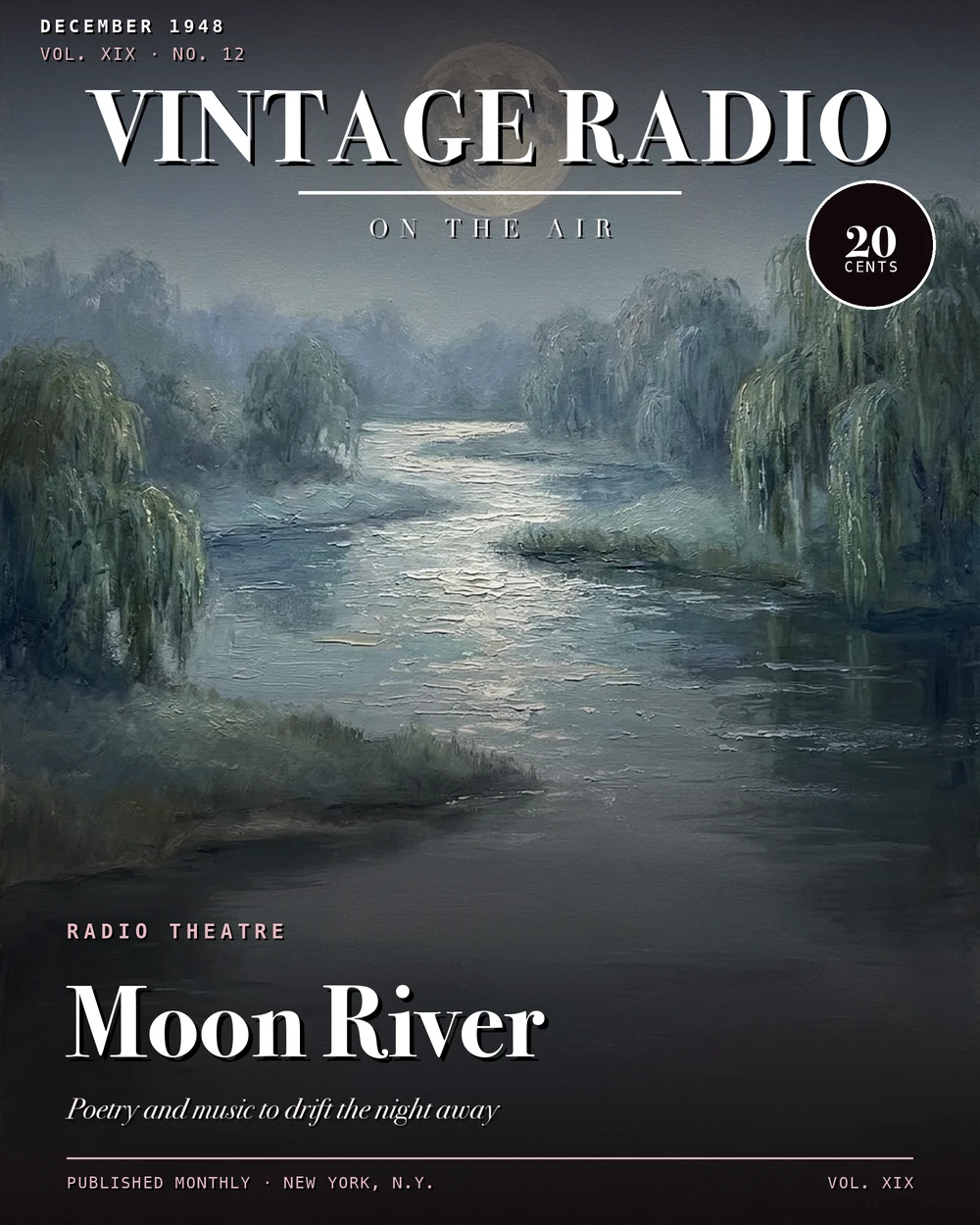
Moon River
Born in a Speakeasy, Heard Around the World
The story of Moon River starts with a speakeasy, a violin, and a station owner who had just bought an organ. In 1930, Powel Crosley Jr. — owner of WLW Cincinnati — called production manager Ed Byron into his office and gave him a direct order: create a poetry show to put the station's new theatre organ to use. Crosley had one more instruction — "None of that dance music" — and he wanted the show ready to air the following night.
Byron retreated to a Court Street speakeasy and sat down with a notepad. A violinist named Virginio Marucci was playing nearby, and at some point Marucci worked through Fritz Kreisler's Caprice Viennois. Something in that melody clicked for Byron, and whatever notes he scratched out that evening became the foundation of a program that would run, in various forms, for roughly four decades. Caprice Viennois became the show's opening theme and stayed there for the entire run.
Moon River aired as a late-night sign-off program, 15 minutes per episode, seven nights a week in its later years. The format was simple and almost hypnotic: narrator, poetry, female vocal, theatre organ, and a closing signature poem that described Moon River as a lazy stream of dreams — a white ribbon twined in the hair of night, carrying listeners toward the land of forgetfulness, the kingdom of sleep, and the realm of Moon River. Announcer Bill Myers, who worked the show for roughly its last dozen years, once called it "one of the few programs designed to put people to sleep." The mattress company that sponsored it — Southern Cross Spring Mattress Company — fit so naturally it barely registered as advertising.
The Signal That Made It National
WLW during the 1930s was unlike any other station in the country. At 500,000 watts — five times the legal limit for commercial broadcasters today — it reached well beyond Cincinnati, well beyond the Midwest, and in the right conditions well beyond the continental United States. The station earned the nickname "The Nation's Station" during this superpower era, and Moon River was one of the programs that traveled farthest on that signal. Fan mail arrived from Europe. WLW alumnus Dick Perry, who later wrote a history of the station, captured the sensation simply: "Turn on a faucet and out came WLW."
That reach meant Moon River was never quite a local show, even though it never joined a national network. It was a local show that the signal made national. Listeners across the country found it at the end of the dial late at night, and the combination of poetry, organ, and that eerie closing poem apparently hit something genuine — something that kept people writing letters and tuning back in for decades.
Powel Crosley had dedicated the studio organ to his mother, which added a layer of personal significance to the instrument at the center of the show. The organ in WLW's Studio A was a significant piece of hardware in its own right: among its features was a Musette rank of pipes so rare that Wurlitzer built only six of them — the other five went to flagship movie palaces including the New York Paramount and the Fox theatres in Detroit, St. Louis, and San Francisco.
The Cast and the Careers It Launched
The narrator was the voice of Moon River, and that role turned over several times. Bob Brown held it first, starting in 1930. Others who followed included Harry Holcomb, Palmer Ward, Charles Woods, Don Dowd, Jay Jostyn, Jimmy Leonard, Ken Linn, and Peter Grant. Each brought something slightly different to the show's characteristic tone of dreamy detachment, but the writing and the music kept the program consistent beneath the changing voices.
Vocalists came and went as well, and the list of names reads like a catalog of mid-century American popular music. Doris Day appeared on Moon River. So did Rosemary Clooney and her sister Betty Clooney, along with Lucille Norman, Ruby Wright, Anita Ellis, Phil Brito, Janette Davis, Barbara Cameron, and the DeVore Sisters. Arthur R. Ainsworth is also listed among the performers. For many of them, Moon River was early work — a step on the way to national careers in recording and broadcasting.
The organists changed too. Charles M. "Pat" Gillick held the bench first, around 1930, playing a three-manual console. Fats Waller reportedly appeared roughly between 1932 and 1934. A story that has circulated in radio circles for years holds that Crosley fired Waller after finding him playing "Ain't Misbehavin'" on the organ dedicated to his mother — though that account has never been confirmed. Lee Erwin is another organist associated with the program in its later years.
The backdrop throughout most of the poetry readings was Claude Debussy's Clair de Lune, which matched the show's late-night mood as naturally as the Kreisler theme that opened it.
Ed Byron's Strange Path Forward
Ed Byron spent five years at WLW after creating Moon River, then left in 1935 to freelance in New York. He had been born in Newport, Kentucky — just across the river from Cincinnati — in 1905, and studied at the University of Cincinnati before working as a newspaper reporter for United Press. Radio pulled him in, and once he was in, it kept him.
In New York he built a reputation as a writer-director, becoming associated with Mr. District Attorney, one of the more successful dramatic programs of the network era. During World War II he served as General Douglas MacArthur's radio officer with the rank of major, and was one of the people behind Radio Guinea, which allowed MacArthur to broadcast during the Pacific campaign. After the war he became president of the New York local of the Radio Directors Guild and eventually head of the national guild, where he organized what was described at the time as "an unprecedented series of air shows costing about $400,000" in opposition to the Taft–Hartley Act.
By 1960 he had joined NBC as an account executive in special program sales. In spring 1964 he moved to ABC to work on a project for restoring top-grade radio drama, which resulted in the anthology series Theatre Five. He died in New Haven, Connecticut, on November 21, 1964 — the same year Theatre Five launched. He was survived by his wife, the former Catherine McCune, and two sons, Christopher and Kevin.
The Long Goodbye
Moon River was not a show that ended cleanly. WLW canceled it in 1953 as the station tried to update its schedule, but a listener write-in campaign brought it back the following summer — a revival that Time magazine noted in a June 1954 article titled "Radio: The Busy Air." That revival kept the show alive through the late 1950s and into the 1960s.
In 1969 the program was cut back to Saturday nights only, crowded out by Cincinnati Royals basketball coverage and a contemporary music program hosted by Jim LaBarbara that ran from seven in the evening until midnight. A Cincinnati Enquirer article from 1970 reported the show had ended shortly after that reduction. One WLW alumnus account gives February 24, 1968, as the date it ended — a figure that may mark a specific personnel or format change rather than the final broadcast. Some sources place the last broadcast as late as 1972.
Whatever the precise end date, the show's hold on Cincinnati didn't disappear quietly. In the years following the final broadcast, a series of Moon River concerts recreated the program before live audiences in the city. In the late 1970s, reruns found a new audience on WVXU, the Xavier University station at 91.7 FM. In 1992, WVXU produced The Moon River Collection, a CD built around five surviving broadcast tracks from 1938, 1945, and 1946. In 1995, WMKV-FM — a Cincinnati station serving older listeners — formally revived Moon River with Bill Myers as narrator, producing approximately 90 new half-hour programs recorded at the Emery Theatre using the former Albee Theatre organ. That revival ran four years.
The Studio A organ most associated with the original program was eventually moved to the Shady Nook Restaurant near Millville in southwestern Ohio, where it fell into disrepair; as of a 1998 report it had become inoperable. One of its rare Musette ranks was relocated to a private theatre organ installation near Thurmont, Maryland.
Roughly 39 recorded episodes survive, running to about nine and a half hours of audio total. Many are undated. Surviving titles include Madrigal (Program 18), Sonnet (Program 20), and Intimations of Immortality (Program 31) — small windows into what the closing signature poem described every night for decades: a lazy stream of dreams, an enchanted ribbon of night, carrying listeners somewhere quiet.